Mellette County Dog Registration Information
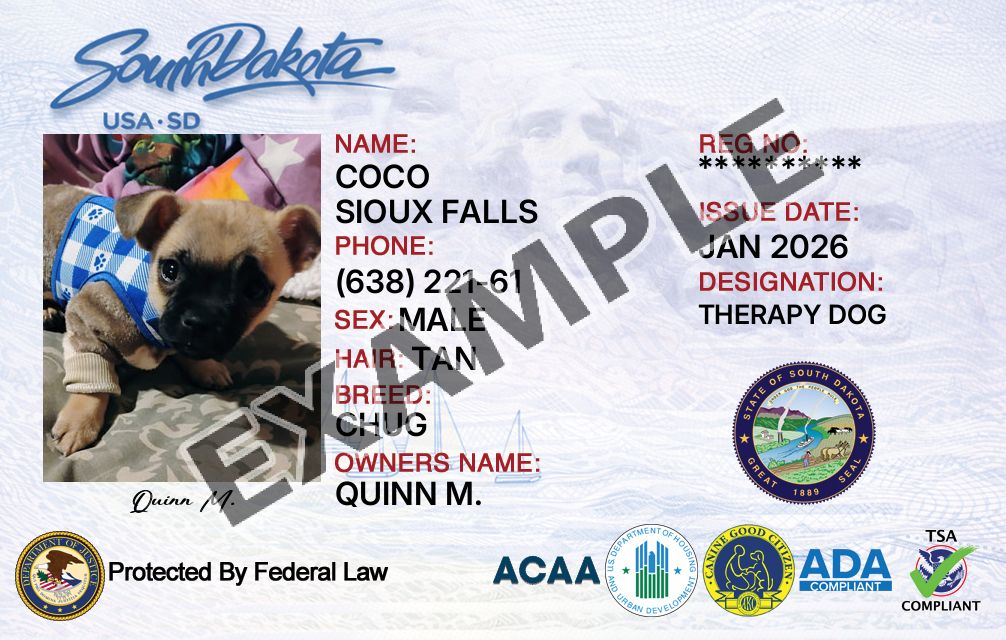
Service Dogs and Emotional Support Animals in Mellette, South Dakota
If you’re asking, “where do I register my dog in Mellette County, South Dakota for my service dog or emotional support dog?” the most important thing to know is that there are two separate topics: (1) local dog licensing (sometimes called “dog tags” or “pet licensing”), and (2) whether your animal is a service dog or an emotional support animal (ESA) under state and federal rules. This page explains where to register a dog in Mellette County, South Dakota, what you may need (like proof of rabies vaccination), and how licensing differs from service dog and ESA status.
- Dog licensing is local (county, city, or town rules). Requirements can vary depending on whether you live inside a city/town limit or in an unincorporated area of Mellette County.
- There is no single universal federal “service dog registry” or “ESA registry” that you must use to make an animal a service dog or an emotional support animal.
- Even if your dog is a service dog or ESA, you may still need a dog license in Mellette County, South Dakota if your city/town or local rules require licensing for dogs kept within their jurisdiction.
Where to Register or License Your Dog in Mellette County, South Dakota
Based on available official and local-government sources, residents of Mellette County may need to work with county offices in White River and/or the city office where they live for dog licensing, animal ordinances, or animal control questions. If you live within an incorporated area (for example, within the City of Mellette city limits), follow that city’s pet licensing process.
Primary County Contact (Courthouse Office Location)
Mellette County Auditor and Welfare Office
- Ask which county department (if any) issues dog licenses for unincorporated Mellette County.
- Confirm whether licensing is handled by a city/town office when you live inside city limits.
- Request the current requirements, fees, and renewal timing that apply to your address.
City of Mellette (Pet Licensing)
- Dog and cat records (rabies and distemper) are due annually by the month of June with associated fees.
- Fee amounts and kennel fees may apply based on number of animals.
- For details within city limits, the city references its animal ordinance and/or the city’s pet/animal committee.
Mellette County includes multiple communities and areas, and rules can differ by municipality. If you do not live in the City of Mellette, confirm whether your town/city office issues pet licenses or whether a county process applies.
If you’re unsure where your address falls (city limits vs. unincorporated), call the county office in White River to verify.
Mellette County Sheriff (Animal-Related Enforcement Questions)
- If you need help with an at-large dog, bite incident, or safety concern.
- If you need clarification on local animal rules as enforced in your area.
- If you’re trying to determine which local agency handles an animal issue where you live.
In some parts of South Dakota, dog licensing is handled by the city/town rather than the county, and requirements can vary. If your specific licensing office for your address cannot be confirmed from published sources, contact the county office in White River and ask which office issues dog licenses for your location in Mellette County.
Overview of Dog Licensing in Mellette County, South Dakota
Dog licensing is local (county/city rules)
When people say “register my dog,” they often mean getting a local dog license (sometimes a tag). In South Dakota, dog licensing requirements are commonly set by local governments rather than one statewide dog-license program. That means the rules for a dog license in Mellette County, South Dakota can depend on whether you live:
- Inside city limits (follow that city’s licensing and animal ordinance process).
- Outside city limits in unincorporated Mellette County (ask the county which office handles licensing, if applicable).
Licensing is separate from service dog or ESA status
A dog license is typically a local administrative requirement tied to public health and identification (such as ensuring rabies vaccination and helping return lost pets). It does not “certify” a dog as a service dog, and it does not create ESA status.
What You Need Before Registering a Dog
Common documents and information
While exact dog licensing requirements in Mellette County, South Dakota can vary by municipality, most local licensing offices ask for similar items. Prepare these before contacting the licensing office:
- Proof of rabies vaccination (often required before a license/tag can be issued).
- Your contact information (name, address, phone).
- Dog information (name, age, breed/color/markings—varies by office).
- Spay/neuter documentation (if your local fee schedule differentiates by altered/unaltered).
- Payment for any license/tag fees (method varies by office).
Vaccination expectations (rabies)
Many local governments require proof of current rabies vaccination for licensing. If your dog’s rabies vaccination is not current, schedule vaccination with a veterinarian and request documentation you can present to the licensing office.
Steps to Register or License a Dog in Mellette County, South Dakota
Step 1: Identify the correct local authority for your address
- If you live in the City of Mellette, use the city’s pet licensing contact and follow city rules.
- If you live elsewhere in Mellette County, call the Mellette County office in White River and ask which office handles licensing for your location.
Step 2: Ask what’s required and when renewal happens
When you contact the office, ask the following so you meet local dog licensing requirements in Mellette County, South Dakota:
- Is a license required for dogs at my address (city limits vs. unincorporated area)?
- What proof is required (rabies, distemper, spay/neuter, residency)?
- What is the renewal timing (annual due dates, late fees)?
- Are there additional rules for kennels or multiple dogs?
- How do you submit documents (in person, mail, email) and how do you pay?
Step 3: Submit proof and keep records
Once licensed (if required), keep a copy of any receipt, tag number, or confirmation for your records. If you receive a tag, follow local rules on whether it must be attached to your dog’s collar.
Service Dog Laws in Mellette County, South Dakota
No universal service dog “registration” requirement
Service dog status is based on what the dog is trained to do for a person with a disability, not on being “registered” in a single nationwide database. In most everyday situations, what matters is that:
- The handler has a disability (as defined under applicable law), and
- The dog is individually trained to perform tasks or work related to that disability.
Licensing and service dogs
If your local jurisdiction requires a dog license, a service dog may still need to be licensed like other dogs, because licensing is usually a local public-health/identification rule (commonly tied to vaccination). Ask the local licensing office if any service-dog fee exemptions exist locally, and what documentation (if any) they accept for that limited purpose.
Emotional Support Animal Rules in Mellette County, South Dakota
ESAs are not the same as service dogs
An emotional support animal (ESA) provides comfort by presence, but ESAs generally do not have the same public-access rights as service dogs. ESA status is typically relevant in specific contexts (such as certain housing situations) and is not created by a local dog license or a universal government registry.
Licensing and ESAs
If a city or local authority requires licensing, an ESA may still be subject to the standard dog licensing requirements for that jurisdiction. In other words, the question “where do I register a dog in Mellette County, South Dakota” is usually answered by the local licensing office—even when the dog is an ESA.
Dog License vs. Service Dog vs. Emotional Support Animal (ESA)
| Category | What it is | Who issues/recognizes it | Common documentation | Typical purpose |
|---|---|---|---|---|
| Dog license (local) | A local license/tag requirement that may apply to dogs kept in a city/town or area; rules differ by jurisdiction. | Local government office (city or county office, depending on where you live in Mellette County). | Often proof of rabies vaccination; sometimes proof of residency and spay/neuter status (varies locally). | Public health and identification; helps return lost dogs; supports enforcement of local animal ordinances. |
| Service dog | A dog individually trained to do work or perform tasks for a person with a disability. | Recognized under applicable disability laws based on training and function; not dependent on a universal federal registry. | Typically no universal required ID card; legitimacy is based on training and the handler’s need. Local licensing may still apply. | Disability-related assistance; may have public access rights depending on the setting and applicable law. |
| Emotional support animal (ESA) | An animal that provides emotional support/comfort; not task-trained in the same way as a service dog. | Status is context-specific (commonly related to housing); not established by a universal government registry. | Often a healthcare provider’s documentation may be relevant for housing-related requests; local licensing may still apply. | Support/comfort in applicable contexts (commonly housing). Generally not the same public-access status as a service dog. |
If you need a dog license in Mellette County, South Dakota, you obtain that from the appropriate local office for your address. If you’re trying to “register” a service dog or ESA, the correct approach is usually to focus on meeting legal definitions and documentation needs for the situation (not enrolling in a universal registry).
Frequently Asked Questions
Where do I register a dog in Mellette County, South Dakota?
Start by identifying whether you live inside a municipality. For example, residents within the City of Mellette follow the city’s pet licensing process. If you live elsewhere in the county, contact the Mellette County office in White River to confirm which local office handles licensing for your address and whether licensing is required in your area.
Do service dogs need a license in Mellette County, South Dakota?
Service dogs are not made “official” by a single nationwide registration. However, if your local jurisdiction requires licensing for dogs, you may still need to license the dog locally. Ask the relevant local office whether any fee exemptions or special local rules apply.
Do emotional support animals (ESAs) need to be registered with the county?
ESA status is not typically created by a county registration. Separately, if a local ordinance requires a dog license, an ESA may still need to be licensed as a dog under local rules. For the most accurate answer, confirm with the licensing office that serves your address.
What documents are commonly needed for an animal control dog license in Mellette County, South Dakota?
Requirements vary locally, but offices commonly ask for:
- Rabies vaccination proof (often required)
- Your current address (and sometimes proof of residency)
- Basic dog details (name/description)
- Spay/neuter documentation if it affects fees
What if I live in a different town within Mellette County?
Local requirements can differ by city or town. If your town has its own animal ordinance and licensing, you usually follow that process. If you’re unsure which rules apply, call the county office in White River and ask which office handles dog licensing requirements for your specific address.
What You May Need
-
Proof of rabies vaccinationOften required before a license/tag can be issued.
-
Proof of residency (if requested)Some offices may confirm your address and jurisdiction.
-
IdentificationA driver’s license or other ID may be requested.
-
Spay or neuter documentation (if applicable)May affect licensing fees in some jurisdictions.
-
Payment for licensing feeAsk the office which payment types are accepted.
Disclaimer
Local laws, fees, office locations, and contact details can change. Residents should verify the most current information with their local animal services or licensing office in Mellette County, South Dakota.
Local SEO Notes (for readers)
If you searched for phrases like “where do i register my dog in Mellette County, South Dakota for my service dog or emotional support dog”, “animal control dog license Mellette County, South Dakota”, or “dog licensing requirements Mellette County, South Dakota”, use the office section above to contact the correct local authority for your address.
The best first step is usually to confirm whether your residence is inside city limits (city licensing) or outside (county guidance on what applies).
Register A Dog In Other South Dakota Counties
Select your county below to get started with your dog’s ID card. Requirements and license designs may vary by county, so choose your location to see the correct options and complete your pup’s registration.
- Aurora County Dog Registration
- Beadle County Dog Registration
- Bennett County Dog Registration
- Bon Homme County Dog Registration
- Brookings County Dog Registration
- Brown County Dog Registration
- Brule County Dog Registration
- Buffalo County Dog Registration
- Butte County Dog Registration
- Campbell County Dog Registration
- Charles Mix County Dog Registration
- Clark County Dog Registration
- Clay County Dog Registration
- Codington County Dog Registration
- Corson County Dog Registration
- Custer County Dog Registration
- Davison County Dog Registration
- Day County Dog Registration
- Deuel County Dog Registration
- Dewey County Dog Registration
- Douglas County Dog Registration
- Edmunds County Dog Registration
- Fall River County Dog Registration
- Faulk County Dog Registration
- Grant County Dog Registration
- Gregory County Dog Registration
- Haakon County Dog Registration
- Hamlin County Dog Registration
- Hand County Dog Registration
- Hanson County Dog Registration
- Harding County Dog Registration
- Hughes County Dog Registration
- Hutchinson County Dog Registration
- Hyde County Dog Registration
- Jackson County Dog Registration
- Jerauld County Dog Registration
- Jones County Dog Registration
- Kingsbury County Dog Registration
- Lake County Dog Registration
- Lawrence County Dog Registration
- Lincoln County Dog Registration
- Lyman County Dog Registration
- Marshall County Dog Registration
- McCook County Dog Registration
- McPherson County Dog Registration
- Meade County Dog Registration
- Miner County Dog Registration
- Minnehaha County Dog Registration
- Moody County Dog Registration
- Oglala Lakota County Dog Registration
- Pennington County Dog Registration
- Perkins County Dog Registration
- Potter County Dog Registration
- Roberts County Dog Registration
- Sanborn County Dog Registration
- Spink County Dog Registration
- Stanley County Dog Registration
- Sully County Dog Registration
- Todd County Dog Registration
- Tripp County Dog Registration
- Turner County Dog Registration
- Union County Dog Registration
- Walworth County Dog Registration
- Yankton County Dog Registration
- Ziebach County Dog Registration